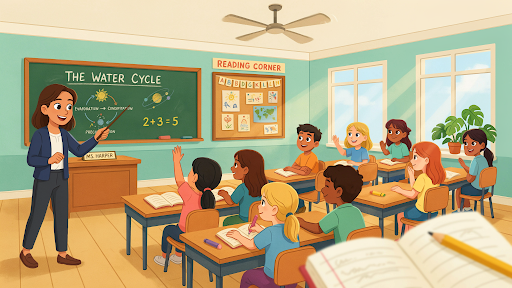
Educational cartoons in modern classrooms can either help a lesson land or waste ten minutes. There is not much middle ground.
Teachers know this already. A random cartoon at the end of class becomes background noise. Students watch it, maybe laugh once, then forget it. But a short animated scene placed right before a difficult explanation, or right after students have struggled with an idea, can do something useful.
It can show what the teacher has been trying to explain.
That is the real value. Not the bright colors. Not the cute characters. Not the fact that it is “digital.” The value is in helping students see, feel, or remember something that was not clear enough before.
1. Some Lessons Need a Picture Before They Make Sense
A few topics are almost unfair to explain only with words.
Evaporation. Digestion. Electricity. Germs spreading. Fractions. A comma changing the rhythm of a sentence.
Students may listen carefully and still not picture what is happening. They are not always confused because the teacher explained badly. Sometimes the idea is just too hidden.
That is where animated educational videos help. Water rises from a puddle. Clouds build. Food moves through the body. A circuit lights up. A character pauses in the middle of a sentence, and suddenly the comma does something.
A good explainer video company should understand that classroom animation is not decoration. It has to clear up confusion. If the video looks nice but students still cannot explain the concept afterward, it has not done the job.
The best classroom cartoons make students say, “Oh, that’s what you meant.”
2. Attention Needs a Reset Sometimes
There is a certain kind of classroom silence that teachers recognize.
It is not focus. It is not calm. It is that quiet moment when half the room is technically present but mentally drifting.
A pencil rolls. Someone checks the clock. A student keeps copying notes but has stopped understanding them.
A short piece of classroom animation can pull the room back without the teacher having to fight for attention. The trick is to use it as a teaching moment, not a break.
Play the clip. Pause it.
Ask something specific.
“What did the character miss?”
“Why did the process stop?”
“What changed between the first try and the second?”
That improves student engagement because students are not being asked to respond from nothing. They have a shared moment in front of them.
Two minutes can be enough. Longer is not always better.
3. Visual Learners Get Another Way Into the Lesson
Some students need the idea to appear in front of them before it settles.
That is not laziness. It is not poor listening. It is simply how many students process information.
Visual learning helps because animation can show order, movement, size, expression, tone, and consequence in one place.
A grammar lesson is a good example. A teacher can explain that a question mark changes the sentence. Students may nod. But when an animated character asks a question, raises their voice slightly, waits, and looks puzzled when nobody answers, the mark suddenly has a purpose.
Fractions work the same way. A pizza cut unfairly, then corrected, can make the difference between one half and one quarter easier to feel.
That kind of learning experience is not about making the topic easier in a lazy way. It gives students another route to the same understanding.
4. Students Remember Little Scenes
Students forget definitions quickly.
They remember moments.
A character forgets to wash hands. Germs move from the desk to the pencil to the lunchbox. A student posts something unkind online and watches another child’s face change. A raindrop travels through the sky, falls, runs into a river, and returns to the sea.
That scene becomes the memory hook.
This is why cartoons help with lesson retention. The lesson is not floating around as a loose instruction. It is attached to an event.
There is usually a mistake, a result, and a correction. Students can talk about that. They can retell it. They can connect it back to the rule.
For health education, digital safety, science, grammar, social studies, and classroom behavior, this matters. The story gives the idea somewhere to live in memory.
5. Sensitive Topics Become Easier to Begin
Some topics make a room uncomfortable before the first sentence is finished.
Bullying. Hygiene. Anger. Personal safety. Respect. Peer pressure. Online behavior. Friendship problems.
If the teacher speaks too directly, students may laugh, hide behind jokes, or pretend the issue belongs to other people. A cartoon gives everyone a little distance.
Now the class is not talking about a student in the room. They are talking about a character.
“What should he have done?”
“Why did that message hurt?”
“What could she say next time?”
These are real benefits of educational cartoons for students. They help teachers begin difficult conversations without making anyone feel exposed.
The topic does not become soft. It just becomes possible to talk about.
6. Animation Can Show Depth That the Board Cannot
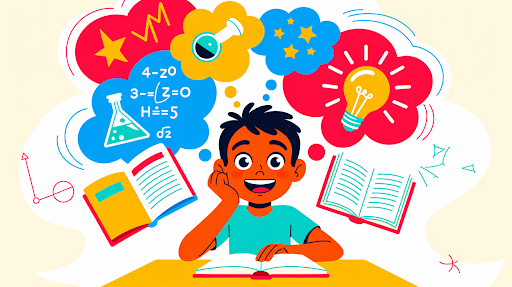
A board drawing can do a lot. So can a textbook diagram.
But some topics need movement and depth.
The inside of a heart. A bridge holding weight. The layers of the earth. A machine part moving from inside. A cell dividing. Electricity traveling through a circuit.
Students may learn the labels and still not understand how the parts work together.
A 3D explainer video company can help when a lesson needs space, scale, structure, or internal movement. Biology, medicine, engineering, geography, architecture, and environmental science all have topics where a flat image is not enough.
This is especially useful for complex concepts. Students can look inside something, move around it, and see how one part affects another.
That said, 3D is not always the right answer. If the lesson is about classroom behavior or a simple language rule, 2D may be cleaner. Use depth only when depth teaches.
7. Stories Help Students Care About the Lesson
Teachers already use stories constantly.
They say things like:
“Imagine a shopkeeper gives the wrong change.”
“Think of a student who forgets their homework.”
“Picture a raindrop moving through the sky.”
“What happens if someone shares a password?”
Cartoons turn those examples into something students can watch.
That is classroom storytelling in a practical form. A character has a problem. A choice is made. Something changes. The lesson appears through the situation, not as a dry instruction.
A 2D explainer video company can create these small story-led lessons for teamwork, classroom behavior, digital safety, communication, emotional learning, financial literacy, and study habits.
2D works well here because these lessons are usually about people and choices.
The story does not need to be dramatic. A small familiar classroom moment is often stronger.
8. Repeating the Lesson Stops Feeling Like Repeating the Lesson
Teachers repeat things because students need more than one pass.
Students, of course, do not always enjoy hearing the same explanation again.
A cartoon changes the route.
The teacher explains the idea. Students watch it happen. The teacher pauses the clip. The class talks through what they saw. Then students try the task themselves.
Same concept. Different path.
That is how cartoons improve classroom learning in a very practical way. The teacher is not simply saying the same thing again. Students are getting another angle.
In math, animation can show each step of a problem. In vocabulary, it can place the word inside a normal situation. In science, it can replay a process slowly enough for students to explain it back.
Sometimes the second explanation works because it does not feel like the second explanation.
9. Cartoons Fit How Lessons Are Shared Now
Most classrooms already move between books, boards, screens, tablets, online portals, homework links, and recorded resources.
Cartoons fit into that routine easily.
A teacher can play a clip during class, send it home for revision, add it to e-learning videos, or share it with a student who missed the lesson. A student who did not understand the topic the first time can replay it later.
That makes cartoons useful digital learning tools, not just entertainment during school hours.
A SaaS explainer video company often understands repeatable guidance because software users need clear steps they can return to when they get stuck. Students need that too. They forget steps. They miss details. They need another look.
This is one reason educational animation for modern classrooms makes sense. It gives teachers a reusable explanation without forcing them to reteach the full topic every time.
10. The Teacher Still Matters Most
A cartoon cannot read the room.
It cannot notice the student who looks confident but is lost. It cannot change the explanation because half the class missed the point. It cannot decide whether students need another example or a harder task.
The teacher does that.
That is why using animated videos in teaching works best when the teacher stays in charge.
A simple structure is often enough.
Introduce the idea. Play a short clip. Pause at the useful moment. Ask what students noticed. Connect it to the worksheet, textbook, discussion, quiz question, or activity.
The video opens the door. The teacher turns it into learning.
Used well, animation supports the lesson. Used carelessly, it becomes screen time with a school label.
Choosing the Right Cartoon for the Lesson
Not every animated video belongs in class.
Some move too fast. Some are too childish for the age group. Some are funny but empty. Some look polished and still skip the exact part students find confusing.
Before using one, a teacher should ask a few honest questions.
What should students understand after watching?
Is the language right for this class?
Does it fit the lesson, or am I forcing it in?
Where should I pause?
What should students do afterward?
That is why teachers use cartoons in lessons when the goal is learning, not filling time.
A cartoon can introduce a topic. It can explain the hard part. It can model behavior. It can help students review before a quiz.
Placement changes the value.
At the start, it can create curiosity. In the middle, it can clear up confusion. At the end, it can help students leave with the main idea still fresh.
Final Words
Educational cartoons in modern classrooms are effective when they are brief, focused, age-appropriate, and linked to a specific teaching aim. They promote visual learning, increase student engagement, clarify complicated topics, and help students retain ideas by using situations rather than simple rules.
They also make delicate issues simpler to address and allow professors to reinforce tough ideas without boring the class. The finest cartoons cannot replace instructors. They give the lesson another way to land.
