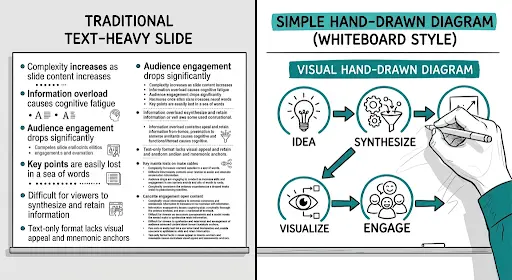
A whiteboard video earns attention one line at a time. It loses it just as fast when the script goes off. This type of video is known as whiteboard animation, and it involves illustrating hand-drawn images with narration, showing the viewer how a particular point is developed. The pace of delivery is crucial to such videos.
We’ve looked at the content that keeps appearing in various studios’ portfolios and rankings and have selected ten pieces that are each useful for a particular reason. They range from training videos to nonprofit campaigns, products, and policy films. Some run 90 seconds. One runs long and still holds up.
Why the Format Still Works
There is scientific backing for this approach, which is unusual for video marketing. In an experiment conducted by researchers from Heliyon in 2023, 133 secondary school students participated in two trials. Progressive drawing produced better retention and transfer scores compared to static images. Narrative made the content more easily transferable, and viewers experienced less stress in narrative presentation.
One important caution from the researchers: a story only helped retention when combined with progressive drawing. The two approaches work together. The sample was students, so treat the findings as directional for adult audiences.
The audience side is just as clear. According to Wyzowl’s 2026 State of Video Marketing report, 91% of companies use video marketing, and 71% of marketers say videos 30 seconds to 2 minutes long are the most effective.
Have a complex message that needs a simple story? Get a custom whiteboard animation built around your brand, your audience and your goals.

10 Whiteboard Animation Examples Worth Studying
1. Workforce Singapore: Leadership and People Management
The video differentiates between assertive and aggressive communication and promotes team building, all for a business learning community. It is the visual element that first catches your attention. It uses only two colors and blocks out everything surrounding the doodle in question, so the eye can focus on it alone. In the conclusion, all the doodles come together into a single composite picture.
2. Harvard Negotiators: Getting to Yes
Based on the negotiation book by Roger Fisher and William Ury, the video argues that good negotiations depend on rapport and understanding. The video is very lengthy. However, it works because it always connects each principle to an understandable situation.
3. Oxfam: Raising Her Voice
Eighty-seven seconds to explain a program that operates in 17 different countries. The cast is intentionally diverse, indicating a global reach without even using a single map. The final frame combines all the illustrations into one picture. It serves as both a resolution and an image that people can easily distribute. Like the Workforce Singapore video, it knows the importance of the last frame being memorable.
4. UNICEF: Data Manifesto
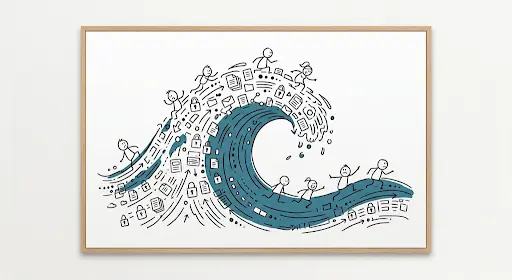
The invisibility of data privacy makes it challenging to illustrate. UNICEF does this by depicting a flood of data that drowns children. This image makes any need for a definition of unregulated data collection superfluous. But the same trick can be used for cybersecurity and compliance as well as for protecting children.
5. WWF: New Hope on Climate Change
The video runs for around two-and-a-half minutes. This video moves from the global problem to what’s being done about it, then to a specific ask. The template includes this structure. The voiceover is clear and emotionally steady, which is important in this issue area.
6. Health Mart
This video targets independent pharmacies, providing information on how the product converts data from finance, clinic, operations, and marketing to reports. It is mostly in black and white, with colors used to highlight significant points. In the regulated industry, which values precision and credibility more than attractiveness, such an approach is appropriate.
7. HomeSquare Maintenance Services
Home maintenance feels like a burden of chores, and so the animation opens up in monochrome. Colors come into play only as the service solves every problem. The narration captures exactly what homeowners think to earn their trust.
8. CitiBank: Home Buying Made Simple
A mortgage is both a technical product and an emotional purchase. This movie uses a character who serves as an audience surrogate, representing the viewer’s concerns about a new city and a new mortgage. The tone is warming, the animation style is very friendly, and the process is easy. Here’s a quick test for your own script. Strip the product out. If there’s still a character with a problem, you have a story.
9. European Commission: Interoperability
Can you explain software interoperability without an illustration? Two violinists who were unable to play together finally synchronized. The characters start as sketches on a notebook page, become paper figures, and act in an open book. The metaphor replaces the technical illustration altogether. It is the hybrid that requires more time and more revisions.
10. USA Football: Youth Coaching
According to the studio’s explanation, the client requested no visible hand holding the marker, while keeping the essence of whiteboard videos and using a bright color palette to suit the young target audience. This proves that whiteboard animation is a process of concept visualization rather than hand usage.
Whiteboard Animation Styles at a Glance
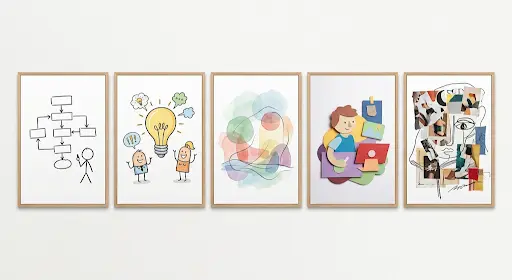
The ten examples above span different sub-styles. Production houses typically classify whiteboard videos into five categories: live-action drawings, doodles/cartoon animations, watercolor/painting styles, cutout/layered styles, and hybrid styles that combine methods. Doodle styles are faster and cheaper because they often use templates. Watercolor and hybrid looks require expertise and take time.
An honest note. Whiteboard is the best for learning purposes like training, onboarding, education, and information campaigns. In marketing, when a whiteboard video looks like it uses a template, it means a budget-friendly video choice. All the above examples are unique and avoid the trap of using templates.
What to Carry Into Your Own Video
Prepare before drawing. Ask two questions: who is specifically watching, and what is the one thing they should do next? If the script can’t answer both in one sentence, it’s not ready yet. Our explainer video script guide explains step by step how you can refine your script.
Be true to time. A 30-second to 2-minute range is fine for marketing videos, but training videos can run longer. Communication training video created by Dana Brownlee – a corporate trainer – goes over 7 minutes and stays engaging through constant visual variety. Length isn’t the enemy. Monotony is.
Next, choose your visual technique deliberately. A restrained color palette, a single metaphor, or even a composite closing frame will make a better effect than drawing faster. If your aim is employee learning, a training video production company will adapt the same approach to your content.
Finally, plan the budget early. Studio guides estimate professional whiteboard animation at $1,500 to $4,000 per minute, depending on the illustrations, voiceover, and revisions needed. Our whiteboard animation cost analysis will explain what drives that number.
Conclusion: Plan Your Own Whiteboard Animation
Complex concepts don’t need a 40-slide PowerPoint presentation. If you have something you want explained quickly, we at Explainer Videos can help script, storyboard, and produce the video.
Send us your concept and audience, and we will get back to you with an appropriate approach and duration, and advise on whether the whiteboard format is appropriate.
Inspired by these examples? Let our team create a whiteboard animation that explains your idea clearly and keeps your audience watching.
