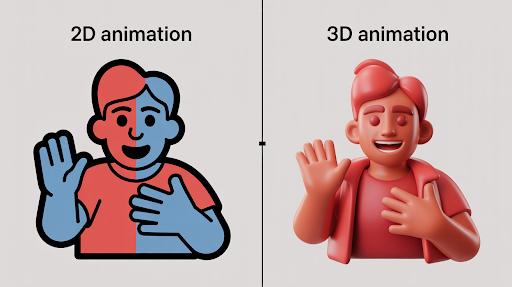
Three companies enter a production meeting with the same question: should the video be 2D or 3D?
One sells project-management software. Another manufactures a compact air purifier. The third is preparing patients for a medical procedure.
The 2D vs. 3D animation choice will not be the same for all three, even if their budgets and video lengths are similar. Each company needs the audience to understand something different.
That is where the decision should begin.
Not with which style looks more expensive. Not with what a competitor used last month. Start with the part of the message that is currently difficult to see, explain, or believe.
Three Briefs, Three Different Visual Problems
The software company wants prospects to understand how much time is lost switching between disconnected tools.
The appliance manufacturer needs buyers to see airflow moving through filters hidden inside the product.
The healthcare organization wants to explain both the patient experience and what happens inside the body.
These are different communication problems. Treating them as one visual question is how brands end up paying for animation that looks impressive but explains very little.
An experienced animated explainer video company should be able to identify the visual problem before suggesting an animation style. A production team that recommends 3D after hearing only the budget is skipping the most important part of the discussion.
The medium should follow the message.
Brief One: The Software Company Does Not Need a Digital Product Model
The software team initially asks for 3D because it wants the launch to feel important.
But the product is not difficult to understand because of its shape. There is no physical object to rotate or open. The confusion sits in the user’s working day.
A manager checks email for one update, opens a spreadsheet for another, and messages two coworkers for the rest. The product brings that information into one place.
That story needs people, timing, and recognizable frustration.
A 2D explainer video company can show the manager moving through the old process, losing time, and then handling the same task more calmly after the software appears. The video can shift between the character, simplified screens, icons, and process graphics without feeling like a technical demonstration.
This is when to use 2D animation for business. The value lives in a situation people recognize, not in the physical construction of a product.
What 2D Can Do Without Feeling Childish?
Some business teams still hear “2D” and picture a playful cartoon.
That is a design choice, not a limitation of the medium.
A financial brand can use restrained colors, precise motion graphics, and simple figures. A healthcare video can use soft movement and realistic proportions. An education company may choose warmer character animation because emotional recognition matters more.
The strength of a 2D explainer video is control.
The production can move from a customer’s home to an office, then into an abstract workflow within seconds. It can show hesitation, delay, relief, or confusion without hiring actors or arranging several locations.
It can also simplify information aggressively. A messy workflow may become four clean steps. An invisible risk can be represented through color or movement. Data can appear beside the character instead of interrupting the story with a separate presentation.
That makes 2D especially effective for services, customer journeys, training, healthcare education, finance, nonprofits, and workplace communication.
The Weakness of 2D Shows Up When Exact Form Matters
Now return to the air purifier.
The marketing team wants buyers to understand why its internal filter arrangement performs differently from cheaper models. A flat diagram could show the parts, but it may not make the airflow or spatial relationship clear.
This is where 2D begins to work harder than it should.
The company does not mainly need a customer story. It needs product visualization.
A 3D explainer video company can remove the outer housing, separate the filters, and move the camera through the unit. Airflow can be represented clearly. The product can rotate while the viewer sees how each part connects.
This is when to use 3D animation for product marketing. The audience needs to inspect something that ordinary footage cannot reveal.
The extra production effort has a clear purpose.
What a Strong 3D Explainer Actually Reveals
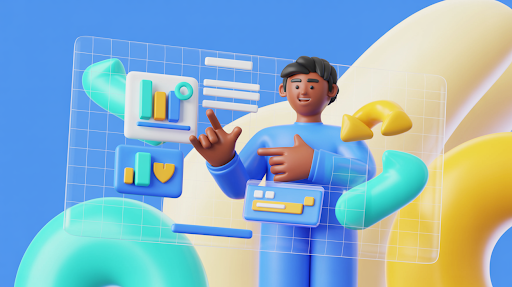
A 3D explainer video earns its budget when depth carries information.
Internal machinery can be exposed without physically cutting the product apart. A medical device can be shown inside the body. An architectural project can be presented before construction. A product still in development can appear finished and working.
The camera is not limited by the real world. It can move through a pipe, beneath a surface, or around a component that is only a few millimeters wide.
Materials matter too.
Metal, glass, fabric, liquid, and plastic can be represented in ways that help buyers understand quality, construction, and use. Good lighting can clarify edges and surfaces. Poor lighting simply makes the object look dramatic.
That distinction matters.
A slow product rotation may look premium, but it is not automatically useful visual storytelling. The shot should reveal a feature, show a relationship, or support a buying decision.
Otherwise, the brand is paying for movement rather than explanation.
The Cost Difference Is Real, but It Is Not Always Simple
3D usually requires more production stages.
A model may need to be built or cleaned from CAD data. Materials are applied. Lights and cameras are placed. Moving parts may need controls. Every finished scene must then be rendered.
That often means a larger video production budget and a longer animation timeline.
Still, the assumption that all 2D is cheaper can cause problems.
A short 3D product spin may be fairly straightforward. A detailed 2D film with frame-by-frame movement, expressive acting, and several original environments may take much longer.
The real difference between 2D and 3D animation pricing comes from what must be designed, how much movement is involved, and how often assets can be reused.
Do not compare the styles by label alone. Compare the actual work inside the scenes.
Brief Three: The Healthcare Video Needs Both
The third company is preparing patients for a procedure.
Part of the video needs to show a person arriving, meeting the care team, and understanding what to expect. Another part needs to explain where a device is placed inside the body.
Neither style can handle the whole message as effectively by itself.
2D can carry the patient journey. It gives the story emotional distance and avoids making the experience feel graphic. The character can show uncertainty at the beginning and greater confidence after the explanation.
Then the production can move into 3D for the anatomy and device placement.
The combination works because each style has a separate job. The transition is not there to make the video feel more varied.
This is the strongest reason to use a hybrid approach.
Human context in 2D. Technical detail in 3D.
Mixed Styles Can Also Waste Money
A hybrid video is not automatically more effective.
Some productions switch from 2D to 3D because the team worries one style will become boring. Others add interface animation, typography, characters, product renders, and live footage to make the film appear larger.
The result can feel disconnected.
Every change in visual language asks the viewer to adjust. That is worthwhile when the new style explains something the previous one could not.
It is distracting when the change exists only for visual novelty.
The best animation style for explainer videos may be one consistent method used carefully. A simple 2D film with a strong script will usually outperform a mixed production with no clear reason for its choices.
Consistency is not dull when the story is moving.
Brand Personality Does Not Decide the Medium by Itself
A serious company can use 2D.
A playful brand can use 3D.
The medium does not create the entire tone. Writing, pacing, color, camera movement, music, sound, and design detail shape how the video feels.
This is where brand identity should guide the execution rather than dictate the format.
A medical 2D video might use calm movement, clean anatomy references, and understated narration. A toy company may use exaggerated 3D shapes and energetic camera work. A premium software brand could combine elegant interface animation with restrained character scenes.
Do not ask whether 2D or 3D matches the brand in general.
Ask how the selected style should be directed so it feels like the brand.
Revisions Feel Different in Each Production Pipeline
A marketing director changes the brand color late in a 2D project. That may be inconvenient, but the team can often update the affected artwork without rebuilding everything.
A product engineer changes the physical shape of a component during a 3D project. That adjustment may affect the model, materials, rigging, animation, lighting, and final renders.
The revision risk is different.
For 2D, settle the character designs, visual system, and storyboard before full animation begins. For 3D, approve the model and key materials before animating detailed scenes.
Product stability matters especially in 3D.
A company launching hardware should not begin final animation while engineering changes are still being made every week. The schedule will suffer, and so will the budget.
Good production planning is not restrictive. It keeps small decisions from becoming expensive ones later.
What Should a SaaS Company Choose?
The question of 2D or 3D animation for SaaS videos is usually easier than software teams make it.
Most SaaS products do not need full 3D.
Their value sits in a task becoming easier, faster, or more organized. A SaaS explainer video company can show the old frustration through a short character scene, then move into a simplified interface demonstration.
UI animation and motion graphics often carry the product portion better than realistic 3D.
There are exceptions.
Software connected to manufacturing, architecture, digital twins, robotics, virtual environments, or spatial computing may benefit from 3D because the platform interacts with physical space.
For ordinary business software, though, 3D can become an expensive layer around a problem that is better explained through people and process.
Show the user first. Show the interface when the story needs it.
A Quick Decision Test
Write one sentence describing what viewers must understand after the video.
If the sentence focuses on a person, service, workflow, emotion, or abstract idea, begin by considering 2D.
If it focuses on construction, internal movement, physical scale, materials, or spatial relationships, investigate 3D.
If the sentence contains both a human experience and a technical process, a hybrid may be justified.
Then test the choice against practical limits.
How stable is the product design?
How many stakeholders will review the video?
Will the assets be reused later?
Does the deadline allow for rendering?
Will the content need regular updates?
These questions are less exciting than browsing animation references. They are also far more useful.
Final Words
The 2D vs. 3D animation decision is not a contest between a basic style and a premium one.
2D is often the better choice for services, characters, ideas, emotions, workflows, and software stories. 3D becomes valuable when the viewer needs to understand physical form, internal construction, movement, scale, or material.
A mixed approach works when each medium solves a distinct part of the explanation.
Start with what the audience cannot currently understand. Once that is clear, the right production style usually becomes much easier to defend.
The best-looking choice is not always the right one.
The clearest one usually is.
