Gated vs. Ungated Video Content: What Drives More Leads?
2026-06-30T15:22:04

Table of Contents
Gated video content leads can fool a marketing team very easily.
The form goes live. A few names come in. Then a few more. By Friday, the report looks decent, and someone says the gated video is “working.”
Maybe it is.
Or maybe sales is about to open a list full of personal emails, fake company names, students, competitors, and people who watched half a minute before leaving.
That happens more than teams like to admit.
A gated video can bring real leads. An ungated video can help bring real leads later. The trick is knowing which job the video is supposed to do before you put a form in front of it.
The Gate Has to Feel Worth It
A gate is not just a form. It is a small trade.
The viewer gives an email, job title, company name, or phone number. In return, they expect something useful enough to justify the interruption.
This is where gated video marketing often gets clumsy. The company thinks the video is valuable because it took budget, meetings, scripts, animation, voiceover, revisions, and approvals. The viewer does not care about any of that.
They care about one thing: will this help me?
A quick company overview usually does not deserve a form. A real product demo might. A technical session that saves someone from booking a call just to understand the basics probably can.
If the trade feels uneven, people leave. Simple as that.
Ungated Video Builds the Trust That Forms Cannot
Ungated video content does not always get enough credit because it may not capture a lead right away.
No form fill. No instant CRM record. No neat number for the weekly update.
Still, it does a quiet job.
A new visitor can watch without pressure. They can understand the product, compare your message with another brand, and decide whether you seem credible enough to keep reading.
That matters.
Homepage explainers, short product overviews, FAQ clips, educational videos, and social cuts usually work better when they are open. These are not always lead-capture assets. They are trust-building assets.
This is where ungated videos for brand awareness are useful. They let the viewer learn before asking them for anything.
Sometimes the first conversion is not a form submission. Sometimes it is just a visitor thinking, “Okay, this company actually explains things clearly.”
Stop Treating Every Viewer the Same
The gated vs ungated video content debate gets much easier when you think about timing.
Someone who has just landed on your website needs clarity. They may not know your product, your category, or even the right words for their problem. That person should not hit a form before they understand the basics.
Someone comparing vendors is different. They may want proof, use cases, customer examples, a webinar, or a more detailed product breakdown.
Someone close to buying is different again. A full demo, implementation walkthrough, technical comparison, or buyer-focused session may be worth a form.
That is the heart of a sensible content gating strategy.
The video is not gated because it is expensive. It is gated because the viewer has enough intent for the trade to make sense.
When Gating Works
Gating works when the content feels specific.
A recorded webinar about a real industry problem. A practical training session. A product demo made for people comparing options. A walkthrough that shows how a complex setup works. A buyer guide that answers questions sales hears every week.
That is how gated videos generate leads without making the audience feel tricked.
The viewer knows what they are getting. The promise is clear. The video sounds useful enough to deserve an email.
This is common in B2B video marketing because B2B buyers usually need more detail before they talk to sales. A manager may need to understand the business case. A technical lead may need to see how the tool fits. A procurement person may need proof that the product is not just another vague platform.
But the form still needs restraint.
A useful webinar can ask for more than a 90-second overview. A deep demo can ask for more than a casual brand video. Match the ask to the value.
When Gating Backfires
The fastest way to hurt a first impression is to hide the first explanation.
A visitor lands on the homepage. They are not sure what you do yet. The explainer video could clear things up, but it is locked behind a form.
Bad move.
The visitor has not received value. They have not built trust. They do not know whether the video is worth their email. So they skip it, or they leave.
That is why should you gate explainer videos usually starts with no.
Homepage explainers should stay open. Product overview videos should stay open. Short “how it works” videos should stay open. These videos exist to remove confusion.
Use explainer video services to make that first explanation sharper. Do not hide it from the people who need it most.
Gate the deeper material. Keep the first layer open.
Lead Count Is Not the Win
A gated video can bring in more contacts. That looks nice.
But lead count can lie.
What matters is what those people do after the form. Did they watch the video? Did they stay past the first minute? Did they click the next CTA? Did sales accept them? Did any of them move into a real opportunity?
That is where lead quality beats lead volume.
A list of 60 serious viewers who watched a full product demo can be worth more than 600 weak contacts who never intended to buy.
Good video lead generation should look at behavior, not just submissions. Someone who watches 85 percent of a demo is giving you a strong signal. Someone who fills the form and leaves after 20 seconds is giving you a different signal.
Both signals matter.
Do Not Make the Form Feel Greedy
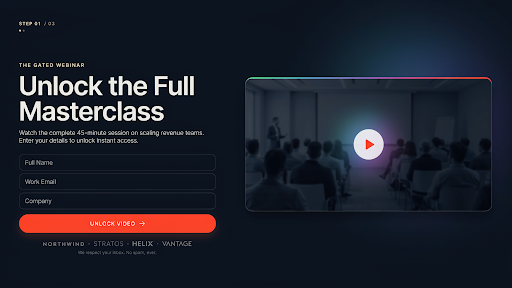
Lead capture forms should ask only for what the next step needs.
For an educational video, even an email field may be enough. For a serious demo, name, work email, company, and role might be fair. For a consultation request, more detail can make sense because the person is asking for direct help.
But phone number? Budget? Team size? Timeline?
Ask too early and people get suspicious.
Every field adds friction. One field may feel easy. Six fields can feel like paperwork.
The best form does not collect everything. It collects enough to follow up properly.
Technical Videos Can Justify the Gate
Some videos have enough substance to sit behind a form.
Think about a medical device walkthrough, machine demo, hardware assembly, industrial process, product mechanism, or architecture visualization. A casual visitor may not care, but a serious buyer might.
A 3D explainer video company can create this kind of asset because 3D can show movement, internal parts, depth, and technical details that normal footage or text may not explain well.
That is the kind of video a buyer may accept a gate for.
Not because it looks fancy. Because it gives them information they cannot get from a quick product page.
Human Stories Usually Need to Stay Open
A 2D explainer video company is often used when the message needs people and situations.
A patient confused by instructions. A support agent drowning in repeat tickets. A manager trying to handle feedback without making the conversation worse. A small business owner stuck with payment problems.
Those videos are doing emotional work. They help the viewer recognize themselves in the problem.
If you block that moment with a form, you may lose the benefit.
Let people watch. Let them feel understood. Let the story make the brand feel clearer and more human.
Ask for contact details later, when the viewer wants something deeper.
SaaS Buyers Want to Learn Before Talking
SaaS teams are often tempted to gate every useful video.
The logic is understandable. Demos took effort. Webinars took planning. Feature walkthroughs explain valuable parts of the product.
But SaaS buyers like to self-educate.
They want to understand features, workflows, integrations, pricing logic, onboarding, and use cases before they speak to sales. If everything helpful is locked, they may simply go to another site that explains more openly.
A SaaS explainer video company would usually separate the videos by intent.
Keep the homepage explainer open. Keep feature overviews open if they help people understand the product. Keep help center and onboarding clips open. Gate full recorded demos, advanced integrations, expert webinars, or implementation sessions when the content is clearly deeper.
That creates a better video marketing funnel. Give enough away to build trust. Gate the pieces that show serious evaluation.
The Follow-Up Matters More Than the Gate
A form fill is not the finish line.
If someone gives their email to watch a video, the next message should match what they watched. Not a generic sales push.
After a webinar, send a short recap. After a product demo, send a use-case video. After a technical walkthrough, send an implementation clip or comparison guide.
This is where lead nurturing videos can do useful work.
Also pay attention to watch behavior. A viewer who watches almost the full demo deserves a different follow-up from someone who leaves after one minute.
The gate gets the contact. The follow-up decides whether the contact goes anywhere.
Measure the Whole Path
Gated videos and ungated videos should not be judged the same way.
For gated videos, look at form completions, watch time, drop-off points, CTA clicks, sales-qualified leads, pipeline, and revenue.
For ungated videos, look at play rate, engagement, scroll depth, return visits, assisted conversions, and CTA clicks near the video.
That gives a more honest view of video conversion rate.
An ungated product video may not capture a lead today. It may help someone understand the product, return later, read a case study, and book a demo next week.
That still counts. It just does not always show up neatly in the first report.
A Rule That Saves a Lot of Bad Decisions
Leave early videos open.
Gate deeper videos when the content is worth the exchange.
If the video explains who you are, what you do, or why the problem matters, keep it ungated. If it helps serious buyers compare, evaluate, implement, or make a deeper decision, consider gating it.
That is the simplest answer to when to use gated video content.
The strongest strategy uses both. Ungated videos build trust. Gated videos capture higher-intent prospects.
Final Words
Gated video content leads can help, but only when the video is worth the form. Ungated videos are better for awareness, trust, first explanations, and product clarity. Gated videos work better for demos, webinars, technical walkthroughs, training sessions, and serious buyer content. Keep early videos open so people understand the brand first. Gate the deeper content that helps qualified prospects move closer to a real decision.
Frequently Asked Questions
Related Articles:

evadmin
Expert contributor to the Explainer Video Company blog.